Magnetic Testing
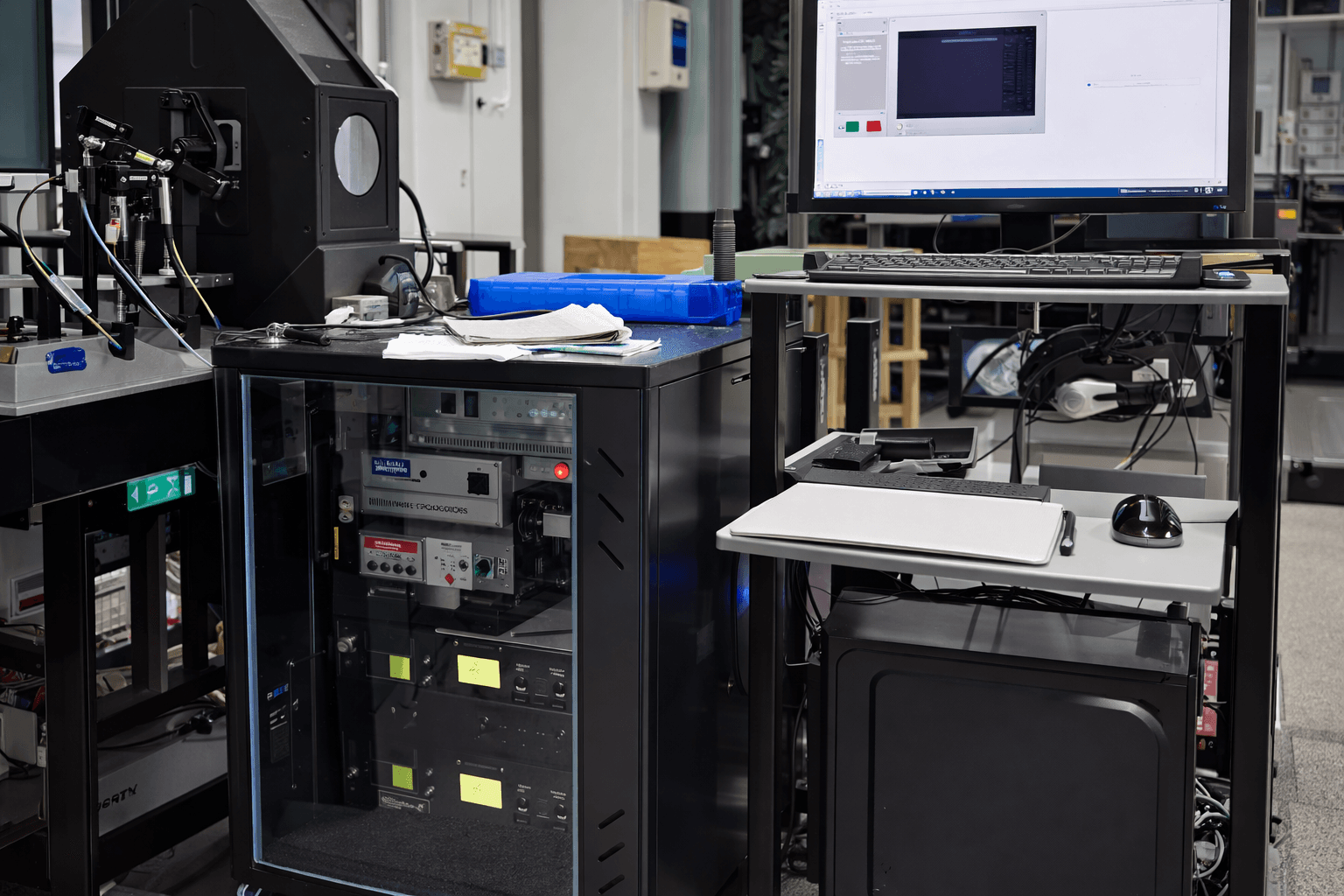
DXMOKE Surface Magneto-optic Kerr Effect System
Magneto-optic Kerr Effect (MOKE)
Surface magneto-optic Kerr effect system for measuring Kerr rotation, ellipticity and hysteresis loops in magnetic thin films, nanostructures and spintronic devices.
Product Overview
Surface Magneto-optic Kerr Effect System
The DXMOKE series magneto-optical Kerr effect system can directly obtain the longitudinal, transverse and polar Kerr rotation angle or the hysteresis loop of ellipticity. It can also determine magnetic properties such as coercive force and saturation magnetic field.
The magneto-optical Kerr effect system (MOKE) is an ideal tool for studying magnetic thin films, magnetic nanostructures and spintronic devices.
In physics, the magneto-optic Kerr effect (MOKE) or surface magneto-optic Kerr effect (SMOKE) describes the changes that occur to light reflected from a magnetised surface. The Kerr angle is the rotation angle of linearly polarised light after reflection from a magnetised sample, while the Kerr ellipticity describes the elliptical polarisation state generated when linearly polarised light reflects from the sample.
Features of DXMOKE Surface Magneto-optic Kerr Effect System
- Uses TTL modulation to control a low-noise laser light source
- High-sensitivity photoelectric sensor tube receives light intensity signals
- Lock-in amplifier collects frequency-locked signals
- Low noise, high resolution and high stability measurement performance
- Highly integrated optical devices for simplified operation
- Users only need to install the sample and fine-tune the sample rod to obtain the Kerr signal
- Integrated Kerr effect measurement with magnetic domain observation microscope
- Microscopic resolution up to 6 µm
- Supports in-situ measurements under vacuum
- Multiple magnetic field and cryogenic configuration options
Basic Functions
Kerr Effect Measurements
The DXMOKE Surface MOKE system provides several advanced Kerr effect measurement capabilities:
- Single-point hysteresis loop measurement
- Longitudinal Kerr effect testing
- Transverse Kerr effect testing
- Polar Kerr effect testing
Surface Area Mapping
The system can move the sample precisely in multiple directions:
- Up / Down movement
- Left / Right movement
This allows mapping of magneto-optical Kerr signals at different surface points.
Magnetic Anisotropy Measurement
The sample or magnetic field can be rotated 360° to determine:
- Easy magnetisation axis
- Hard magnetisation axis
- Magnetic anisotropy properties
Magnetoelectric Coupling Test
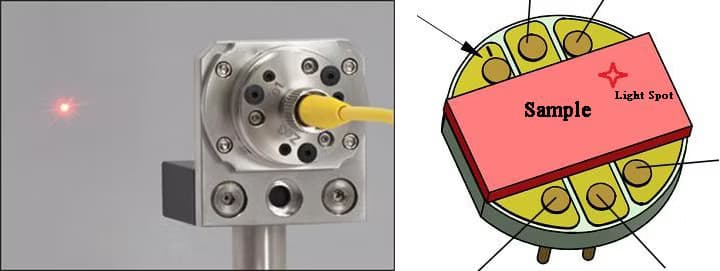
The sample holder includes an electrical interface which enables magnetoelectric coupling measurements.
Integrated Microscope Observation
A high-speed CCD camera and microscope system are integrated into the instrument. Functions include:
- Surface topography observation
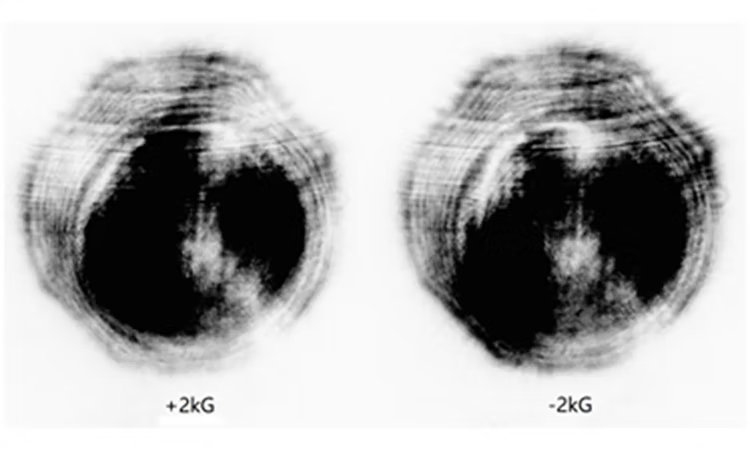
- Magnetic domain imaging using a polariser
- Detection of light intensity changes caused by magnetic field-induced polarisation changes
Technical Parameters
Measurement Performance
- Kerr angle resolution: < 0.001°
- Ellipse resolution: < 0.1%
- Minimum laser spot size: 10 µm
- Maximum magnetic field: 2.2 T (with EM7 electromagnet)
Motion Control
- Rotation angle step: 0.1°
- Sample movement resolution: 10 µm in X/Y directions
System Noise
- Noise level: < 1%
Cryogenic Option
An optional cryogenic configuration enables low-temperature measurements with the following performance:
- Temperature range: 100 K – 300 K
- Temperature control accuracy: ±0.01°C
- Cooling time to 100 K: ≈ 30 minutes
- Heating rate: 0.01 – 30°C/min
- Sample placed in a vacuum environment
- K9 optical glass window minimises magneto-induced optical rotation
Related Products
Explore adjacent systems and categories that are commonly evaluated together in hard magnetic testing workflows.